

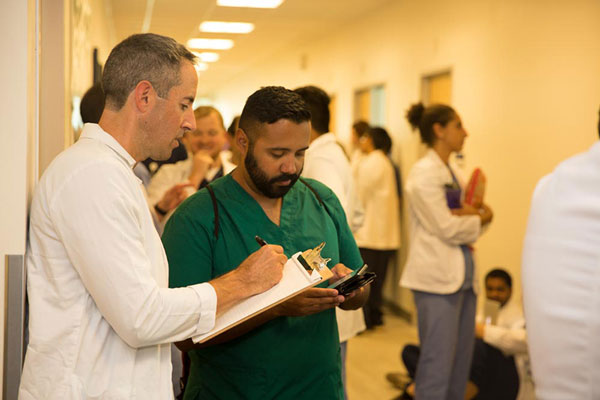
When one envisions a medical student in their first two years, they might picture a student at a desk in front of a laptop, day and night. It's not far from the truth: You'll find plenty of students reviewing the usual subjects in medical school and familiarizing themselves with the standard functions of the human body.
Intro to Clinical Medicine class is no different than basic sciences. The foundation of clinical sciences is to understand what's normal before understanding the disease. We are taught to complete a physical exam on patients that are in good physical form, so we know what to recognize and expect in a healthy patient.
This is the foundation of the learning process in medical school. Once you know what “normal” looks like, you can be proficient in recognizing when a specific enzyme in a pathway is not functioning, when a hormone isn’t performing its mechanisms, or when a specific muscle may not be working properly, to name a few examples.
Yet, as practicing physicians, things are vaguer. For instance, a patient might come to your office and say, “I have been coughing for the past two weeks.” After hearing that, in your head, you evaluate all the body’s pathways, then go through those which, when not functioning correctly, present with a cough. This is to shape in your mind a question bank to pick from to ask the patient. This way of thinking is unique, and not the same as you would use during your average test.
AUC has exposed us to the importance of the clinical approach from the first semester. They present patient assessments gradually from the beginning to get students comfortable with this idea. You have to be able to communicate with a patient and while speaking derives all possible reasons for their complaint. Listening to the patient speak about what’s going on helps you reason through a case to come up with a good differential.
These skills have been impressed on me now for a little over a year since I am in the fourth semester. I am capable of being on my own with a patient and content to talk with confidence, certain of a good outcome, because I was trained with a guideline for patient interaction.
All my hard work has led me up to take a focused history. Taking a focused history in a simulation center is how I would envision seeing a patient in real life. We rehearse in an examination room talking with a standardized patient, discussing their reason for coming in to see a doctor. Now, having had considerable practice through AUC’s focus on clinical medicine, I can formulate good questions and come up with broad differentials.


